Natalia Goncharova: Three Young Women (image from here)
These days art exhibition catalogues seem to dominate my serious reading. At present it's Natalia Goncharova - an exhibition on at Tate Modern.
I first encountered this artist in a postcard of the above image. When I started working in London in the early 1970s I was a frequent visitor to museums and galleries where there was a wide range of postcards of the collections available. Not having the means to purchase magazines and books in those days, I did binge on postcards which I would stick up on my walls at work. The above was one of those, but I did not know anything about the artist.
Natalia Goncharova: Hay cutting (image from here)
Now I am discovering all about her through the splendid catalogue. So many of her paintings, unlike the one at the top, remind me of my early childhood summers in northern Greece and the views in the '50s of farming activity in the landscapes we passed with the train across Europe.
Natalia Goncharova: Linen (image from here)
The religious paintings chime with the icons which surrounded me, and the lovely painting immediately above reminds me of the laundry near our flat where to my wide-eyed childish fascination they used irons just like the one pictured. When I was about four, when I was the only child in the whole extended family, there were many aunts alive, and we would go for glorious picnics when the days seemed to stretch forever. I find that Goncharova's paintings chime with my memories of those times. This is especially true of the image below which is from Eirene's blog A Place Called Space and her post on the Natalia Goncharova exhibition at the Tate.
Natalia Goncharova: Apelsinia (image from here)
This catalogue is therefore not only full of information but also a lovely reminder of a most enjoyable time in my life.
Showing posts with label Reminiscence. Show all posts
Wednesday, July 10, 2019
Friday, February 08, 2019
Reminiscence reading
Written on the back: Olga and Anna on the roof of St George's, 1958
After my mother died I was suddenly aware that I am the sole custodian of so many memories from my youth. The Greek relatives of my generation were either at least ten years older than me (and so many now dead, like Anna with me above), or were not born for at least six years after me.
With the birth of a great-niece, as I have no children, I decided to put together a book explaining who everyone in my and my brother's part of the family was/is. Since completing that, I have been thinking that I might enjoy putting together a loosely organised collection of my own reminiscences. This goes happily with my desire to explore more of the interests spurred in my young days, but never pursued to any great degree.
Mosaics on the dome of St George's (image from here)
One of those interests is in mosaics, especially Byzantine mosaics. This started at the age of four when my great uncle used to take me to his work. He was architect/civil engineer involved in the restoration of the church of St Demetrius in Thessaloniki. He would leave me to amuse myself looking around, and I was particularly taken with the glorious mosaics (I was an exceedingly well behaved child - and besides, everyone knew who I was). Recently I came across the website of Helen Miles, a mosaic artist who was inspired by Byzantine mosaics and has a post on the Rotunda here. Her fascinating blog posts got me fired up with interest again, and so when the other day I was researching books on the subject to get me started, I discovered one on my beloved Rotunda, I had to have it.
Vintage postcard -Artist's view of the Rotunda, Thessaloniki (image from here)
Spending three or four months every summer in Thessaloniki through my youth, I was allowed a lot of freedom. I was able from about the age of seven or so to walk through the town on my own, setting off from home as it was then up on the hill next to St Demetrius, down to my aunt's office to collect her at the end of her working day at 1 o'clock. I had ample opportunity to explore so much of such a fascinating place, which in my early years was a beautiful mix of medieval and belle epoque architecture. (So much was ruined with the blocks of flats which went up from the mid 50s, and now I find the place so filled with mediocre buildings that it is difficult to imagine how it once was.)
I loved the many churches, their shapes, their mosaics, their icons, ... but of all the buildings the one which intrigued me the most was St George's, the Rotunda. I was delighted when our home in Thessaloniki moved down to within a couple of minutes' walk to the Rotunda. When I knew the building it was neglected, not used as a church, and only visited by very few folks who deliberately sought it out. In its garden full of weeds, bits of stone ruins, and often junk, I saw my first sarcophagus.
The Rotunda transformed into a mosque, 1831 (image from here)
The inside was awe-inspiring, especially when I was alone. It had lived different lives: Roman rotunda first, then a christian church, then a mosque, and then a sort of neglected museum ... until the earthquake of 1978, after which it was swathed in scaffolding, and taken more seriously.
The postcard above shows how the Rotunda and its surroundings looked when I first remember it. Now it is all cleared out, and linked with the Arch of Galerius - both part of the same original construct. I am both glad, and sad - as I am with so many aspects of things that have changed over my life.
Rotunda and Arch today (image from here where the whole Roman complex is also picutred)
It is scarcely believable now that my father (who took the photograph of us), my cousin Anna, and I at the age of ten were allowed to climb right up and sit on the roof - but the photo clearly shows the minaret and how high we were. The book arrived yesterday, and I am looking forward very much to putting some information with my memories.
After my mother died I was suddenly aware that I am the sole custodian of so many memories from my youth. The Greek relatives of my generation were either at least ten years older than me (and so many now dead, like Anna with me above), or were not born for at least six years after me.
With the birth of a great-niece, as I have no children, I decided to put together a book explaining who everyone in my and my brother's part of the family was/is. Since completing that, I have been thinking that I might enjoy putting together a loosely organised collection of my own reminiscences. This goes happily with my desire to explore more of the interests spurred in my young days, but never pursued to any great degree.
Mosaics on the dome of St George's (image from here)
One of those interests is in mosaics, especially Byzantine mosaics. This started at the age of four when my great uncle used to take me to his work. He was architect/civil engineer involved in the restoration of the church of St Demetrius in Thessaloniki. He would leave me to amuse myself looking around, and I was particularly taken with the glorious mosaics (I was an exceedingly well behaved child - and besides, everyone knew who I was). Recently I came across the website of Helen Miles, a mosaic artist who was inspired by Byzantine mosaics and has a post on the Rotunda here. Her fascinating blog posts got me fired up with interest again, and so when the other day I was researching books on the subject to get me started, I discovered one on my beloved Rotunda, I had to have it.
Vintage postcard -Artist's view of the Rotunda, Thessaloniki (image from here)
Spending three or four months every summer in Thessaloniki through my youth, I was allowed a lot of freedom. I was able from about the age of seven or so to walk through the town on my own, setting off from home as it was then up on the hill next to St Demetrius, down to my aunt's office to collect her at the end of her working day at 1 o'clock. I had ample opportunity to explore so much of such a fascinating place, which in my early years was a beautiful mix of medieval and belle epoque architecture. (So much was ruined with the blocks of flats which went up from the mid 50s, and now I find the place so filled with mediocre buildings that it is difficult to imagine how it once was.)
I loved the many churches, their shapes, their mosaics, their icons, ... but of all the buildings the one which intrigued me the most was St George's, the Rotunda. I was delighted when our home in Thessaloniki moved down to within a couple of minutes' walk to the Rotunda. When I knew the building it was neglected, not used as a church, and only visited by very few folks who deliberately sought it out. In its garden full of weeds, bits of stone ruins, and often junk, I saw my first sarcophagus.
The Rotunda transformed into a mosque, 1831 (image from here)
The inside was awe-inspiring, especially when I was alone. It had lived different lives: Roman rotunda first, then a christian church, then a mosque, and then a sort of neglected museum ... until the earthquake of 1978, after which it was swathed in scaffolding, and taken more seriously.
The postcard above shows how the Rotunda and its surroundings looked when I first remember it. Now it is all cleared out, and linked with the Arch of Galerius - both part of the same original construct. I am both glad, and sad - as I am with so many aspects of things that have changed over my life.
Rotunda and Arch today (image from here where the whole Roman complex is also picutred)
It is scarcely believable now that my father (who took the photograph of us), my cousin Anna, and I at the age of ten were allowed to climb right up and sit on the roof - but the photo clearly shows the minaret and how high we were. The book arrived yesterday, and I am looking forward very much to putting some information with my memories.
Labels:
Art / Craft/Architecture,
Reading,
Reminiscence
Monday, December 31, 2018
New Year
Edinburgh floral clock (image from here)
Tempus doesn't half fugit! On this last day of 2018, I am looking forward - hoping for positive progress on so many fronts, personal, national, global. I thought as illustration for this post I would use the Princess Street Gardens floral clock in Edinburgh. When I was very young in the early 50s my mother and I used to travel once or twice a year from the Borders where we lived to Edinburgh for the day by coach. The treats included a trip to Woolworth's to buy a Dean abridged classic, and then down to the floral clock before eating our sandwiches further down the gardens. It used to thrill me. Of course as I grew up, and later lived in Edinburgh the clock faded to insignificance in my life. But in such a state of depressing current affairs, I am determined to focus on small pleasures, and make the most of them.
Wishing you all exquisite joys in 2019.
Tempus doesn't half fugit! On this last day of 2018, I am looking forward - hoping for positive progress on so many fronts, personal, national, global. I thought as illustration for this post I would use the Princess Street Gardens floral clock in Edinburgh. When I was very young in the early 50s my mother and I used to travel once or twice a year from the Borders where we lived to Edinburgh for the day by coach. The treats included a trip to Woolworth's to buy a Dean abridged classic, and then down to the floral clock before eating our sandwiches further down the gardens. It used to thrill me. Of course as I grew up, and later lived in Edinburgh the clock faded to insignificance in my life. But in such a state of depressing current affairs, I am determined to focus on small pleasures, and make the most of them.
Wishing you all exquisite joys in 2019.
Saturday, December 01, 2018
Admiring the anthology form
I have been wanting a non-online source of thought and ideas - a physical object to wander through, mull over, and enjoy. Of course I encountered just such an anthology online!
My first encounter with anthologies which made me pause and admire was when I started teaching English and Drama in 1970. It was in a bookshop rather than the school book cupboard that I found publications by Penguin Education. Such brilliant books, they were a tremendous boost to me and my teaching - and my learning about teaching. I regretted that I left the books behind when I left the school.
When I went on to work for an educational publisher myself, I took those Penguin anthologies to be a kind of gold standard to aim for. Editing, commissioning, and designing anthologies at Oxford University Press taught me so much - not least through seeking content: texts and illustrations. We wanted to provide access to education through books of delights - to reward and stimulate further curiosity, while fulfilling the same for ourselves in their making.
When seemingly unaccountably Penguin closed their up to then successful education division, we at OUP education were delighted to be able to take on some of their anthology publications.
But I had gone on to Children's books by then with a different publisher. (Educational texts are for children, but they are bought by or prescribed by schools, while Children's books are bought (diminishingly) by libraries and parents/relatives.) I would not, unfortunately, be involved with commissioning anthologies again in my career.
But as I say, I have recently felt the need. Magazines seem increasingly superficial to me; I need something with a bit more of a chew. So I have decided to give Elementum a try. Both images above are from here where there are reviews. And another review here - which points out one of the aspects which drew me to the publication, that the issues are books rather than magazines. They are like collections of short stories in that the whole does not have to be read from beginning to end - but short stories including non-fiction, poetry, and splendid visuals, both art and illustration.
I've only just started the first volume, with the theme of Calling, inspired by living near the sea, and I am certainly hearing the siren song so far.
My first encounter with anthologies which made me pause and admire was when I started teaching English and Drama in 1970. It was in a bookshop rather than the school book cupboard that I found publications by Penguin Education. Such brilliant books, they were a tremendous boost to me and my teaching - and my learning about teaching. I regretted that I left the books behind when I left the school.
When I went on to work for an educational publisher myself, I took those Penguin anthologies to be a kind of gold standard to aim for. Editing, commissioning, and designing anthologies at Oxford University Press taught me so much - not least through seeking content: texts and illustrations. We wanted to provide access to education through books of delights - to reward and stimulate further curiosity, while fulfilling the same for ourselves in their making.
When seemingly unaccountably Penguin closed their up to then successful education division, we at OUP education were delighted to be able to take on some of their anthology publications.
But I had gone on to Children's books by then with a different publisher. (Educational texts are for children, but they are bought by or prescribed by schools, while Children's books are bought (diminishingly) by libraries and parents/relatives.) I would not, unfortunately, be involved with commissioning anthologies again in my career.
But as I say, I have recently felt the need. Magazines seem increasingly superficial to me; I need something with a bit more of a chew. So I have decided to give Elementum a try. Both images above are from here where there are reviews. And another review here - which points out one of the aspects which drew me to the publication, that the issues are books rather than magazines. They are like collections of short stories in that the whole does not have to be read from beginning to end - but short stories including non-fiction, poetry, and splendid visuals, both art and illustration.
I've only just started the first volume, with the theme of Calling, inspired by living near the sea, and I am certainly hearing the siren song so far.
Wednesday, October 24, 2018
Seamstress
The word seems so old fashioned now, but very recently brought to my mind, evoking memories of childhood. First there is the Vuillard exhibition at the Barber Institute of Fine Arts in Birmingham. I am currently reading - savouring the catalogue, (image above). A review of the exhibition can be found here.
I am a great fan of Vuillard's intimist work, enjoying it much more than many other of his contemporaries perhaps because he does for me capture so much of the atmosphere which surrounded me as a small child in Thessaloniki, Greece in the very early 1950s. The UK was forward-looking then, and by contrast the life I encountered with my relatives in Greece was backward-looking. Refugees in the '20s, they had come from divers locations but were closely related, and met often, and mostly told stories about the past. Looking back as I grew up, it felt as if I had vicariously lived in a previous century as well as the present.
There was electricity, but because of the strong sunlight during the day, the shutters were often closed and we moved about in the dim light so often seen in Vuillard's paintings. The rooms were full of women. Most of my relatives were aunts and great-aunts, and older cousins who had survived their husbands. Their clothes were black. There were few shops with clothes because everyone went to a seamstress. The two we frequented were also Pontic Greek refugees.
My mother paid very little for the clothes that were made for us because not only did we bring our own fabric, but also we used to haul out of date pattern catalogues on our trans-European train journey. The seamstresses did not need paper patterns, but were delighted to receive the drawings that showed the garments: nearly up-to-date styles. They were remarkable women who achieved a great deal with small reward. As we ourselves could afford more, we brought more than enough fabric so that they could use the remainder for themselves, whether for other clients or no. In fact I never saw our main seamstress wearing anything other than her slip, with a pin cushion tied round her wrist.
Edouard Vuillard: Atelier de Couture de Madame Vuillard (image from here)
The second evocation of my earliest encounters with a seamstress was brought to mind when I went for a breast screen last week. The radiographer was so gentle she reminded me of my grandmother's and aunts' fittings for brassieres. In the earliest '50s such garments were not available in any shops in Thessaloniki, but there were seamstresses who specialised in the architectural design and manufacture of corsets and brassieres. As a toddler I was like Vuillard an observer, amazed by all of the experiences.
Alas, as the years and decades went by there was less and then no work for the latter seamstress as mass manufacture and sale of underwear became ubiquitous. I continued to have dresses made for me until I became engaged in 1969, but after that I became a tourist in Greece, no longer living there for the whole season of summer.
But Vuillard's paintings bring it all back to me.
Edouard Vuillard: The Thread (image from here)
I am a great fan of Vuillard's intimist work, enjoying it much more than many other of his contemporaries perhaps because he does for me capture so much of the atmosphere which surrounded me as a small child in Thessaloniki, Greece in the very early 1950s. The UK was forward-looking then, and by contrast the life I encountered with my relatives in Greece was backward-looking. Refugees in the '20s, they had come from divers locations but were closely related, and met often, and mostly told stories about the past. Looking back as I grew up, it felt as if I had vicariously lived in a previous century as well as the present.
There was electricity, but because of the strong sunlight during the day, the shutters were often closed and we moved about in the dim light so often seen in Vuillard's paintings. The rooms were full of women. Most of my relatives were aunts and great-aunts, and older cousins who had survived their husbands. Their clothes were black. There were few shops with clothes because everyone went to a seamstress. The two we frequented were also Pontic Greek refugees.
My mother paid very little for the clothes that were made for us because not only did we bring our own fabric, but also we used to haul out of date pattern catalogues on our trans-European train journey. The seamstresses did not need paper patterns, but were delighted to receive the drawings that showed the garments: nearly up-to-date styles. They were remarkable women who achieved a great deal with small reward. As we ourselves could afford more, we brought more than enough fabric so that they could use the remainder for themselves, whether for other clients or no. In fact I never saw our main seamstress wearing anything other than her slip, with a pin cushion tied round her wrist.
Edouard Vuillard: Atelier de Couture de Madame Vuillard (image from here)
The second evocation of my earliest encounters with a seamstress was brought to mind when I went for a breast screen last week. The radiographer was so gentle she reminded me of my grandmother's and aunts' fittings for brassieres. In the earliest '50s such garments were not available in any shops in Thessaloniki, but there were seamstresses who specialised in the architectural design and manufacture of corsets and brassieres. As a toddler I was like Vuillard an observer, amazed by all of the experiences.
Alas, as the years and decades went by there was less and then no work for the latter seamstress as mass manufacture and sale of underwear became ubiquitous. I continued to have dresses made for me until I became engaged in 1969, but after that I became a tourist in Greece, no longer living there for the whole season of summer.
But Vuillard's paintings bring it all back to me.
Edouard Vuillard: The Thread (image from here)
Thursday, October 18, 2018
Dedicated to books and reading
My grand sorting really has led to a great project which has gripped me. I am not devoting every minute to it, but somewhere in the back of my mind thoughts are churning away.
I wrote a post about the initial idea last month, and since then my interest has deepened, and I have realised just how personally relevant the project is. My career was in publishing, and specifically in children's non fiction and in educational publishing. From 1977 - 81 I was a commissioning editor in London for Blackie, whose gazetteer I am now canibalising. That gazetteer came from my Scottish grandparents' house - and Blackie was a Scottish publishing house. (It was one of the Blackie family who commissioned Charles Rennie Mackintosh to design Hill House.)
I also had a passion for encyclopedias and gazetteers when I was a child. For Christmas 1953 I was given the complete Arthur Mee's Encyclopedia, and I have had a thirst for reading for information ever since.
So, all in all, I can see that this project will occupy quite a bit of my thinking and designing for a while.
I wrote a post about the initial idea last month, and since then my interest has deepened, and I have realised just how personally relevant the project is. My career was in publishing, and specifically in children's non fiction and in educational publishing. From 1977 - 81 I was a commissioning editor in London for Blackie, whose gazetteer I am now canibalising. That gazetteer came from my Scottish grandparents' house - and Blackie was a Scottish publishing house. (It was one of the Blackie family who commissioned Charles Rennie Mackintosh to design Hill House.)
I also had a passion for encyclopedias and gazetteers when I was a child. For Christmas 1953 I was given the complete Arthur Mee's Encyclopedia, and I have had a thirst for reading for information ever since.
So, all in all, I can see that this project will occupy quite a bit of my thinking and designing for a while.
Thursday, September 06, 2018
Brilliant book
(The front cover and interior illustrations are by Fabulous Cat Papers)
Today I spent the whole day reading Handywoman by Kate Davies. I found it as compulsive as any well crafted whodunnit novel - more so indeed because it is so many books combined. It is biography, a harrowing account of how she learned how to work half of her body, and how to appreciate living with the continuing results, a glimpse of her academic work on how the domestic and the intellectual need not be seen as mutually exclusive, ... it explores the importance of knitting *, and the development of her online business, ....
I came across Kate Davies' original blog Needled at at time when I needed support with being my mother's sole carer just before and after her stroke. Davies' positive outlook in the blog was a great encouragement to me, and my mother enjoyed hearing about the exploits - despite her own depression and negativity. Captivated, I have continued to follow the new blog, and through it have also come to think about perhaps moving back to Scotland.
*The thoughts on knitting can indeed be applied to any hand work.
Today I spent the whole day reading Handywoman by Kate Davies. I found it as compulsive as any well crafted whodunnit novel - more so indeed because it is so many books combined. It is biography, a harrowing account of how she learned how to work half of her body, and how to appreciate living with the continuing results, a glimpse of her academic work on how the domestic and the intellectual need not be seen as mutually exclusive, ... it explores the importance of knitting *, and the development of her online business, ....
I came across Kate Davies' original blog Needled at at time when I needed support with being my mother's sole carer just before and after her stroke. Davies' positive outlook in the blog was a great encouragement to me, and my mother enjoyed hearing about the exploits - despite her own depression and negativity. Captivated, I have continued to follow the new blog, and through it have also come to think about perhaps moving back to Scotland.
*The thoughts on knitting can indeed be applied to any hand work.
Saturday, September 01, 2018
Words, words, words
I have been fascinated by words for longer than I can remember. I was an unplanned child, born at a time when my parents had no space and less money. I was with my mother all the time while my father studied at university and my mother either embroidered tea cloths for pin money or studied English. I grew hearing two languages: Scots English and Greek.
My mother did her language learning out loud, reciting, reading to me. We learned to read together. I did not know that was what I was doing. Then before I was one year old we went to Greece, and I as surrounded by aunts with other sounds: Greek. Apparently I was silent for a worrying time before embarking on my attempts.
Then back to Scotland for my second birthday - back to sounds I had almost if not forgotten. Then back to Greece when I was three - this time silent for four weeks before I began to speak fluently, in Greek, appropriately pronounced, with idiom, and including (unknowingly) Pontic Greek expressions (much delight and clapping - and pinching of my cheek!).
I returned to Scotland after my fifth birthday in order to start school. I had forgotten my English. The three day train journey across Europe started in panic - I could understand what my mother said to me in English, but I could not find the words in myself to speak. A kind university student, returning from vacation on the same train dedicated himself to reminding me first of nouns by pointing, then gradually of everything else. (I would have suffered so much more if we had simply flown as is normal today!)
In those very early years I realised that it's not just a difference of vocabulary. Body language is also different, and thought processes, reactions, fine expression of emotions. How much of a potential to understand more is missed when only being in possession of one language.
I went on to learn French then German, and was lucky enough to spend some time in each country. Then by studying literature and language development at university doors and windows were opened and my understanding and curiosity grew. Poetry became a joy rather than an embarrassing tedious chore of rote learning and recitation. A career in publishing drew on all of the above, and contributed the additional delights of typography: the visual aspects of language, lettering, and layout.
Imagine then my recent dilemma when faced with a 19th century sample book - containing a partial gazetteer as I try to whittle down our over-large collection of books. Was it simply sentimentality which was making me want to keep it? By William Morris's dictum it is neither of use nor beauty - or was it? What on earth could I do with it.
All at once I knew what to do. I scanned the pages which most appealed. And within this post are the initial experiments for my new project.
My mother did her language learning out loud, reciting, reading to me. We learned to read together. I did not know that was what I was doing. Then before I was one year old we went to Greece, and I as surrounded by aunts with other sounds: Greek. Apparently I was silent for a worrying time before embarking on my attempts.
Then back to Scotland for my second birthday - back to sounds I had almost if not forgotten. Then back to Greece when I was three - this time silent for four weeks before I began to speak fluently, in Greek, appropriately pronounced, with idiom, and including (unknowingly) Pontic Greek expressions (much delight and clapping - and pinching of my cheek!).
I returned to Scotland after my fifth birthday in order to start school. I had forgotten my English. The three day train journey across Europe started in panic - I could understand what my mother said to me in English, but I could not find the words in myself to speak. A kind university student, returning from vacation on the same train dedicated himself to reminding me first of nouns by pointing, then gradually of everything else. (I would have suffered so much more if we had simply flown as is normal today!)
In those very early years I realised that it's not just a difference of vocabulary. Body language is also different, and thought processes, reactions, fine expression of emotions. How much of a potential to understand more is missed when only being in possession of one language.
I went on to learn French then German, and was lucky enough to spend some time in each country. Then by studying literature and language development at university doors and windows were opened and my understanding and curiosity grew. Poetry became a joy rather than an embarrassing tedious chore of rote learning and recitation. A career in publishing drew on all of the above, and contributed the additional delights of typography: the visual aspects of language, lettering, and layout.
Imagine then my recent dilemma when faced with a 19th century sample book - containing a partial gazetteer as I try to whittle down our over-large collection of books. Was it simply sentimentality which was making me want to keep it? By William Morris's dictum it is neither of use nor beauty - or was it? What on earth could I do with it.
All at once I knew what to do. I scanned the pages which most appealed. And within this post are the initial experiments for my new project.
Labels:
Doodle,
Food for thought,
Inspiration,
Project,
Reminiscence
Friday, August 03, 2018
A long hot summer
I particularly enjoy a copper beech in the summer because it stands out magnificently from the ubiquity of green. It also seems to look cooler in days of burning sun.
(image from here)The last time I remember us having such a long hot summer was in the extraordinary year of 1976. I was fortunate to be working at Oxford University Press in Oxford, in a building that has enormously thick walls, and so arriving early and leaving late I avoided much of the heat.
(image above from Bing maps showing the replacement tree today-ish)
Also, in the quadrangle there was a giant copper beech, taller than the building, which created a delightful shade under which to eat lunch if there was a wee breeze. Unfortunately I learned some years ago that the tree died; but has been replaced by a youngster, who has a hundred years or so to go to catch up with its predecessor.
Another memory from that summer is receiving a phone call from an artist who was always coming up with excuses for late delivery - this time it was that the extreme heat had caused his mother-in-law's garden shed to explode!
Tuesday, July 24, 2018
Thursday, May 17, 2018
Giving a fig
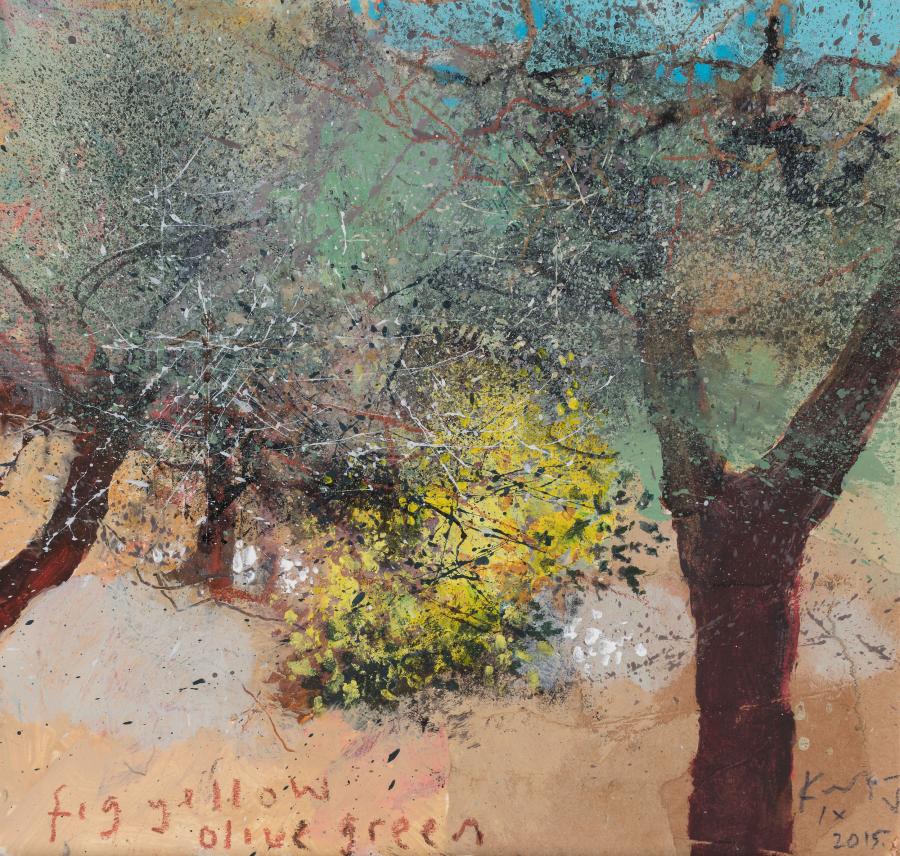
I have been inspired by Mags Ramsey's post on the current exhibition of Kurt Jackson's work. The first image alone transported me to my childhood. My favourite summer fruit was the fig (and my favourite winter fruit the pear), and I have not eaten a really ripe tasty fig since I was in my teens, some fifty years ago. Sigh. I remember well reaching up and gently pulling the warm ripe fruit from the tree.
Kurt Jackson: Fig yellow, olive green (image from here)
Reading Mags' post, and looking at the images from the Olive and Fig: Provence exhibition on Messum's website I was filled with a desire to make a figgy picture myself to commemorate my lost fig-eating days.
Adrian Paul Allinson: The Fig Tree (image from here)
First, however, I had a quick google through some other figgy art. Here are a few that caught my eye.
Heather Mackinlay: Fig tree abstracted (image from here)
Paul Klee: Fig Tree (image from here)
Catherine Forshall: Figs II (image from here)
Xchristakos: White fig tree (image from here)

Dee Schenck Rhodes: Fig tree (image from here)
And this is my first pass scribble towards a working doodle for Giving a fig.
Kurt Jackson: Fig yellow, olive green (image from here)
Reading Mags' post, and looking at the images from the Olive and Fig: Provence exhibition on Messum's website I was filled with a desire to make a figgy picture myself to commemorate my lost fig-eating days.
Adrian Paul Allinson: The Fig Tree (image from here)
First, however, I had a quick google through some other figgy art. Here are a few that caught my eye.
Heather Mackinlay: Fig tree abstracted (image from here)
Paul Klee: Fig Tree (image from here)
Catherine Forshall: Figs II (image from here)
Xchristakos: White fig tree (image from here)

Dee Schenck Rhodes: Fig tree (image from here)
And this is my first pass scribble towards a working doodle for Giving a fig.
Labels:
Caught my eye,
Doodle,
Inspiration,
Reminiscence
Monday, October 23, 2017
Signs of excitement
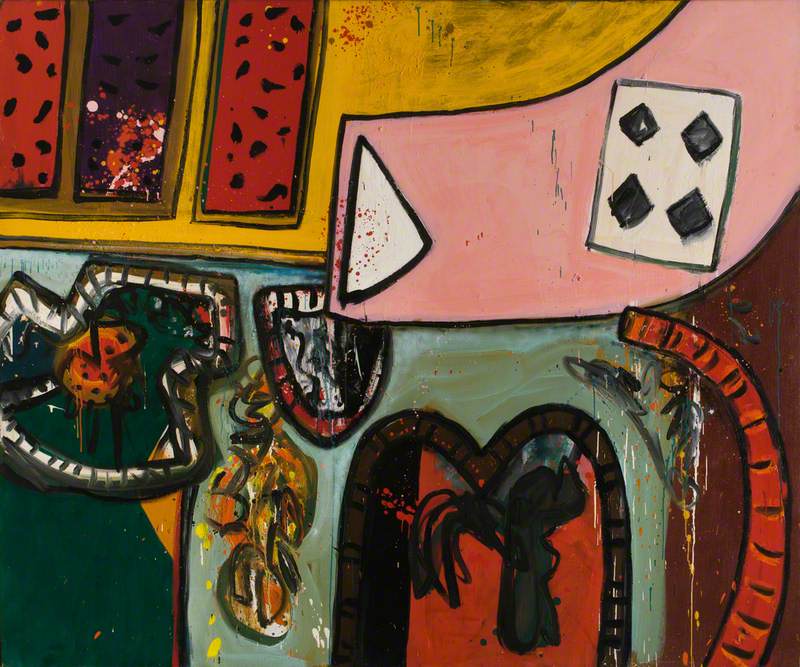
Alan Davie: Woodpecker's Choice (image from here)
I have nothing to write about my work at present - not that I am not working. Stitch, stitch, stitch. However, in the cracks of time between doing I keep going back to the ArtUk site to poke my memory.
Alan Davie: Diptych for a Tame Spider (image from here)
In the late 60s I was fortunate to spend several afternoons in the Richard Demarco gallery, and to meet various artists. Sometimes those artists were kind enough to spend time talking with me about their work - or just generally chatting. One such was Alan Davie. Alan Davie: Wheels for the Sweet Life (image from here)
His work to me was an explosion of seductive chaos - compelling, exciting, demanding, yet strangely familiar, friendly. The symbols - exuberant, colourful, irrepressible signs jazzed up my thinking. Yet he treated me as an equal. Such an invaluable encounter.
Alan Davie: Playing Card Adventure No.4 (image from here)
I cannot remember the individual paintings which were in that exhibition, but from the ArtUk page I have chosen those of the right dates. Here is the Tate Gallery's obituary - his death coincided with a display of their works of his.
I have nothing to write about my work at present - not that I am not working. Stitch, stitch, stitch. However, in the cracks of time between doing I keep going back to the ArtUk site to poke my memory.
Alan Davie: Diptych for a Tame Spider (image from here)
In the late 60s I was fortunate to spend several afternoons in the Richard Demarco gallery, and to meet various artists. Sometimes those artists were kind enough to spend time talking with me about their work - or just generally chatting. One such was Alan Davie. Alan Davie: Wheels for the Sweet Life (image from here)
His work to me was an explosion of seductive chaos - compelling, exciting, demanding, yet strangely familiar, friendly. The symbols - exuberant, colourful, irrepressible signs jazzed up my thinking. Yet he treated me as an equal. Such an invaluable encounter.
Alan Davie: Playing Card Adventure No.4 (image from here)
I cannot remember the individual paintings which were in that exhibition, but from the ArtUk page I have chosen those of the right dates. Here is the Tate Gallery's obituary - his death coincided with a display of their works of his.
Friday, October 20, 2017
Poached eggs and other savoured memories
Diego Velazquez: An old woman cooking eggs (image from here)
I had been exposed to a wide variety of visual art from my earliest years, but I was over 11 years old before I entered an institutional art gallery. My first visit was to the Scottish National Gallery with my secondary school in Edinburgh. I subsequently visited many times after that, both with the school, but mostly alone. The year I took History of Art as part of my degree (still in Edinburgh) I was there at least once a week.
Several of the paintings there remain prominently in my head and in my heart, but my favourite of all is the Velazquez above. I find it a complete stunner that never shuts down my curiosity. It presents the possible beginning, or middle, or maybe even the end of many stories. The skill of course is breath-taking. And I love that my grandmother's mortar and pestle are there right at the front. I remember as a small child battering the shape out of walnuts using those heavy brass instruments that I was barely able to lift!
Inevitably one of my other favourites is the now widely known The Reverend Robert Walker Skating on Duddingston Loch (perhaps) by Raeburn. (image above from here)
Daniel Macnee: A lady in grey (the artist's daughter)
And a much less well known lady whom I used to greet on every visit: A Lady in Grey. This again had a personal connection because it was unusual to have a portrait showing a young woman engaged in an occupation which dominated my leisure hours: hand stitching.
Paul Gauguin: Vision of the Sermon (Jacob wrestling with the Angel)
In my teenage years I was obsessed by all things French (none of my family knew anything about France or the French, so my interest was left well alone), and so inevitably I was drawn by the strikingly dramatic Gauguin - indeed the whole painting cried out to me before I knew who had made it. (If you scroll down the page linked under the image above you will find a short film which chimes very much with my own youthful experience - strangely enough we were reading The moon and sixpence at school around the time of my first visits to the gallery.)
Edgar Degas: Woman Drying Herself
The other French painting which stays with me from those early days is a Degas pastel. I had loved both the realism and the looseness, the chalkiness of the pastel as well as its subtle colour - without at that point knowing anything about the material. Later, during my art history studies the tutor who specialised in Post Impressionism told us that this work had had the glass cleaned so assiduously that the pastel had now transferred from the paper to the glass! I do not know whether this is really true.* And I don't know whether my curiosity about and my love of soft pastels came from this work and the story.
Of course I discovered many other delights in the collection, and during the intensive art history visits learned so much about them all - a sweet consolation for not being permitted to study to be an artist myself - but these five works in particular have a special place in my memory. Over the decades ever since then I have continued to look, to discover, to pursue my curiosity, to research not only the art that appeals, but also the art that does not appeal. I believe that finding out why something does not capture one's delight can illuminate and develop one's looking and understanding.
I must admit to doing a bit less of the latter now. I seem to have reached a point when - with some exceptions - I want to save my art curiosity for delving deeper into the realms that I already enjoy. Nowadays that seems to feed my own work much more, and I save my wider curiosity for other subjects such as Roman architecture, satellite mapping of the oceans, and geology (all current or imminent FutureLearn courses).
*I don't think it can be true because the implication in 1967 was that years of cleaning had lifted the pastel off the paper, and yet I now see that the work was only donated to the gallery in 1960. I must have seen it first not long after that gift took place.
I had been exposed to a wide variety of visual art from my earliest years, but I was over 11 years old before I entered an institutional art gallery. My first visit was to the Scottish National Gallery with my secondary school in Edinburgh. I subsequently visited many times after that, both with the school, but mostly alone. The year I took History of Art as part of my degree (still in Edinburgh) I was there at least once a week.
Several of the paintings there remain prominently in my head and in my heart, but my favourite of all is the Velazquez above. I find it a complete stunner that never shuts down my curiosity. It presents the possible beginning, or middle, or maybe even the end of many stories. The skill of course is breath-taking. And I love that my grandmother's mortar and pestle are there right at the front. I remember as a small child battering the shape out of walnuts using those heavy brass instruments that I was barely able to lift!
Inevitably one of my other favourites is the now widely known The Reverend Robert Walker Skating on Duddingston Loch (perhaps) by Raeburn. (image above from here)
Daniel Macnee: A lady in grey (the artist's daughter)
And a much less well known lady whom I used to greet on every visit: A Lady in Grey. This again had a personal connection because it was unusual to have a portrait showing a young woman engaged in an occupation which dominated my leisure hours: hand stitching.
Paul Gauguin: Vision of the Sermon (Jacob wrestling with the Angel)
In my teenage years I was obsessed by all things French (none of my family knew anything about France or the French, so my interest was left well alone), and so inevitably I was drawn by the strikingly dramatic Gauguin - indeed the whole painting cried out to me before I knew who had made it. (If you scroll down the page linked under the image above you will find a short film which chimes very much with my own youthful experience - strangely enough we were reading The moon and sixpence at school around the time of my first visits to the gallery.)
Edgar Degas: Woman Drying Herself
The other French painting which stays with me from those early days is a Degas pastel. I had loved both the realism and the looseness, the chalkiness of the pastel as well as its subtle colour - without at that point knowing anything about the material. Later, during my art history studies the tutor who specialised in Post Impressionism told us that this work had had the glass cleaned so assiduously that the pastel had now transferred from the paper to the glass! I do not know whether this is really true.* And I don't know whether my curiosity about and my love of soft pastels came from this work and the story.
Of course I discovered many other delights in the collection, and during the intensive art history visits learned so much about them all - a sweet consolation for not being permitted to study to be an artist myself - but these five works in particular have a special place in my memory. Over the decades ever since then I have continued to look, to discover, to pursue my curiosity, to research not only the art that appeals, but also the art that does not appeal. I believe that finding out why something does not capture one's delight can illuminate and develop one's looking and understanding.
I must admit to doing a bit less of the latter now. I seem to have reached a point when - with some exceptions - I want to save my art curiosity for delving deeper into the realms that I already enjoy. Nowadays that seems to feed my own work much more, and I save my wider curiosity for other subjects such as Roman architecture, satellite mapping of the oceans, and geology (all current or imminent FutureLearn courses).
*I don't think it can be true because the implication in 1967 was that years of cleaning had lifted the pastel off the paper, and yet I now see that the work was only donated to the gallery in 1960. I must have seen it first not long after that gift took place.
Labels:
Artist,
Caught my eye,
Food for thought,
Reminiscence
Friday, July 07, 2017
Playing
Several years back a friend and I used to work closely together. We did our own thing, but every three weeks met, and gave ourselves exercises to stimulate thought, work, and discussion. Life got in the way, and the close association dissolved, and I do miss that constant stimulus.
Of late I have felt myself on a kind of plateau - plenty of projects to process, but a whiff of same-old same-old creeping into my horizon view. So, I decided to do two positive things.
First I shall not fret. I have a lot to be getting on with, as is the way with hand work - so on with that I shall get. Meantime I shall set myself exercises.
A long time ago when I was similarly in the doldrums about what new fiction to read in order to widen my experience, I set myself the exercise of for instance buying the thinnest book on a shelf, or one with a red cover, or the first one I saw with something specific in the cover design, or title, ... etc. I encountered very few duds, and enjoyed the stimulating experience greatly.
So, for my first exercise I chose a square sketchbook (from my embarrassingly large pile of empty or almost empty sketchbooks!), pastels, made myself a stencil, and was to use at least one postage stamp (from a collection my brother and I had as children - he does not want them, and I am thus slowly disposing of them). The stencil I made is of a group of five running figures.
The image at the top of this post is the first attempt, with a stamp of one of my favourite mosaics. I decided that the stamps I chose should have some personal meaning for me, and the one below reminds me of the hours I spent in Singapore airport in the mid-1980s! (I was flying out to Jakarta for work every couple of months, with an eight hour wait at Changi between planes - those trips involved me watching a lot of tropical fish!)
After my first attempt at the exercise I wanted deliberately to do something that needed 'editing'; working on in some further way. So this was a lot looser in approach.
I tried not to have any idea of what that further work might be, but as I scanned the scribble this morning my memory dredged up a photo of water lily leaves I had taken a couple of years ago. So I had a little play with that.
Monday, May 01, 2017
May day
We have had both sunshine and rain today, as is appropriate for May Day, heralding the end of Spring and the beginnings of Summer. I have been remembering traditions I took part in when I was small - even when not so small: I washed my face in the May Day dawn dew in Edinburgh until I married and left home. One of these women pictured here could have been me as I did go up Arthur's Seat a couple of my years at university to complete the ritual (I wasn't there then - 1965 was my first year at university, so that May I would still have been at school). Those were the days before we thought about acid rain and other general pollutants!
I was only in Greece for one May Day that I remember - it must have been in the early 1950s. A group of aunts took me out to the country the day before in order to gather wild flowers and branches of flowering shrubs which we then wove into a wreath to hang on the balcony. The wreath then stayed there until Midsummer. It certainly was not as professional looking as the one illustrated above from here.
Subscribe to:
Posts (Atom)