I was excited when I found out that the courtyard sculpture for this year's RA Summer Exhibition was to be by Thomas Houseago. His figurative work has struck me as so fresh, of our condition today, as well as giving a nod to the past.
It is always invigorating to find artists who take existing ideas and subjects and through rendering those ideas in their own style add value, give another perspective. Thus the ideas grow and our thinking is expanded.
The figures are monumental, and yet vulnerable.
They are accumulations, and so much more than the sum of their parts.
They still excite and inspire me.
Overall this year's Summer Exhibition was successful for me. I saw the work of three powerful artists: Turrell, Rego, and Houseago, which would have been reward enough itself. But I also saw many works which I found attractive and gave me pleasure.
James Turrell: Mors - Somnus (07) Medium Diamond Glass (image from here)
One work in the RA Summer Exhibition that was worth the visit alone for me was James Turrell's light piece in a quiet cool dim room. The diamond square of light changes colour ever so gradually, and not an even flat colour. Subtle tones are spread across the whole square, radiating from its centre. The square is set in a white wall, not black as shown above. Except that it does not look white: as the colour changes in the square its subtleties are signalled first in what you apparently see of the opposing colours in the surrounding wall. Those of you who typed on the original word processors will remember that the bilious green text would conjure up red letters when looking away or shutting eyes.
This piece of Turrell's - as so many of his - is extraordinary colour work. This is where Mondrian was leading.
This work was compulsive viewing, entrancing, thought-provoking, and so joyous. This is an artist who makes me look at the world again and again, and think about what I am seeing.
Banksy: KEEP OU (image from here)
After so many decades of looking at images, pictures, paintings, what is it that catches my eye? Often it is familiarity - or perhaps lack of familiarity. Certainly one aspect which holds my eye is composition. It does not have to be drama, but there needs to be a reward of some kind. The image must make me think - and think beyond the question of how it was made. For me content is queen and must definitely rule over technique. This is easier for me with painting because I don't paint. Content is still supreme although more difficult with prints as I am familiar with the techniques, and that can intrigue even if the image is not satisfactory to me. This is all personal preference needless to say.
Glen Onwin: Shades of Darkness - Light and Colour (Goethe's Theories) Blue, Red, Yellow. Earths Major Cycles (image and title from here)
Individual works are easily overlooked at the RA Summer Exhibition, and one reason why Gallery IV was my favourite is that the hang was relatively sparse. Works had room to breathe and be themselves. Glen Onwin's framed pigments (above) were arresting, being the physical embodiment of colour; pigment which was gradually accumulating at the base of each frame.
David Remfry: Chandelirium (image from here)
I very much enjoy being surprised to find that a work which attracts my eye is by an artist who is familiar, but in this case unfamiliar. This was my delight in seeing David Remfry's painting above.
Stephen Chambers: Portrait of Agatha Roman (image from here)
Portraits can be so interesting, whether the subject is known or not. Stephen Chambers' Portrait of Agatha Roman is perhaps from his Court of Redonda series, and she intrigued me additionally because her hands seemed to have a separate life of their own.
Sonia Lawson: Homage to Courbet (image from here)
Another portrait which intrigued me was Sonia Lawson's Homage to Courbet, which is so different from Courbet's own self portrait - as well as being different from the cabinet-of-curiosities style of Lawson's with which I have been familiar of recent years.
Tony Bevan: Self Portrait (image from here)
A self portrait which really caught my eye near the end of the exhibition struck a philosophical note - 'I think, therefore I am'. Tony Bevan has produced several self portraits, and this is not quite a brain, but it caught my imagination.
I liked many other paintings, but these above held my attention for more than the passing pleasurable moment.
Paula Rego: Death of the Virgin (image from here)
In an exhibition like the Royal Academy Summer Exhibition it is inevitable to encounter works by familiar artists, either by Academicians themselves, or Honorary Academicians, or by familiar invited artists. Often the reaction is - oh, there's another one by so-and-so, and the feeling is of a so-what-ish kind. Of course this doesn't mean that the work is not good; simply that a previous example struck a more positive response. Indeed I had that reaction to the Anselm Kiefer painting in this year's exhibition.
Paula Rego: Agony in the Garden (image from here)
Four paintings by Paula Rego, however, did affect me greatly, despite my having seen so many of her similar works before.
Paula Rego: Deposition (image from here)
What hits me first is the substance. They not only are full of dimension, the paintings carry so much within them. The subtle use of materials gives on the one hand a quality of fabric in the dresses that I can feel: a stiffness of stuff, as if those dresses are the armour, support for the tender flesh within them. And on the other, the delicate but firm pencil lines outlining such as the ears, the curls of loose hair signal that tenderness.
Paula Rego: The Visitation (image from here)
There is so much here that I looked and looked for some considerable time, and felt so many reactions from exhilaration through joy to disquiet. For me these four are in a class of their own, so I shall cover the other paintings which drew my attention in a separate post.
Thomas Houseago: Untitled (Red Man) (image from here)
This year's RA Summer Exhibition had yet again presented something different. For me one outstanding positive was the number of sculptures which delighted, starting with Thomas Houseago's work in the courtyard.
The main lift was not working today, and so I was escorted through the labyrinthine corridors backstage to a staff lift to get to the main exhibition.
Marcus Harvey: Napoleon Invictus (image from here)
The first large room, Gallery III, is mostly full of paintings, but on a half-wall of their own are Marcus Harvey's pieces, two busts Napoleon Invictus and Full Nelson either side of his painting Victory.
Marcus Harvey: Full Nelson (image from here)
This trio benefited greatly from their virtual isolation. I found that the rest of the room looked good as a whole, but that nothing else leapt out for my attention.
Thomas Schutte: Mann Ohne Gesicht (image from here)
The next sculpture which captured my attention was by Thomas Schutte, entitled Man without face. The stance of the man in shallow water was enough to draw me to look closer, then I saw that his face had been cut off, and that this was in his right hand. I found this to be a quiet, powerful statement.
Room IV, hung this year by Barbara Rae, was my favourite room as a whole. I enjoyed more individual pieces of work in here as well as the look of the whole.
David Mach Easy tiger (image from here)
Two sculptures caught my attention - one of which certainly could not be ignored. David Mach's Tiger covered in Tunnock's teacakes foil was in this gallery when I saw it. Fun, certainly, and of course prompted the thought of how many of the teacakes he'd eaten himself.
Nicola Hicks: Bear from dump circus (image from here)
The second sculpture appealed to me more, and had a poignancy to it as well as aesthetic attraction: Nicola Hicks' Bear from dump circus.
Tim Shaw: Parliament (the voices in your head) (image from here)
Gallery V came a very close second favourite; it was hung again by Barbara Rae, this time with Hughie O'Donohue, and contained a great many interesting prints. The sculpture which I loved, however was by Tim Shaw: Parliament (The voices in your head). The whole as presented is more complex than shown in the photograph. There are additional pieces of detritus: cardboard boxes, torn paper, and there is an audio tape running. I was intrigued and delighted.
Janet Mullarney: Dancer (image from here)
The two other sculptures which particularly appealed to me were both figurative: one by an artist I have not encountered before, and one by an old favourite. I have not consciously met Janet Mullarney's work previously, but a quick look at her website and her galleries here and here make me want to find out more.
Mimmo Paladino: Untitled (image from here)
Mimmo Paladino, on the other hand is someone whose work I have enjoyed looking at over many years.
There were other sculptures which I enjoyed, but these were the stand-out ones for me. I shall write further posts on prints and paintings.
- and I am seeking cooling greens.
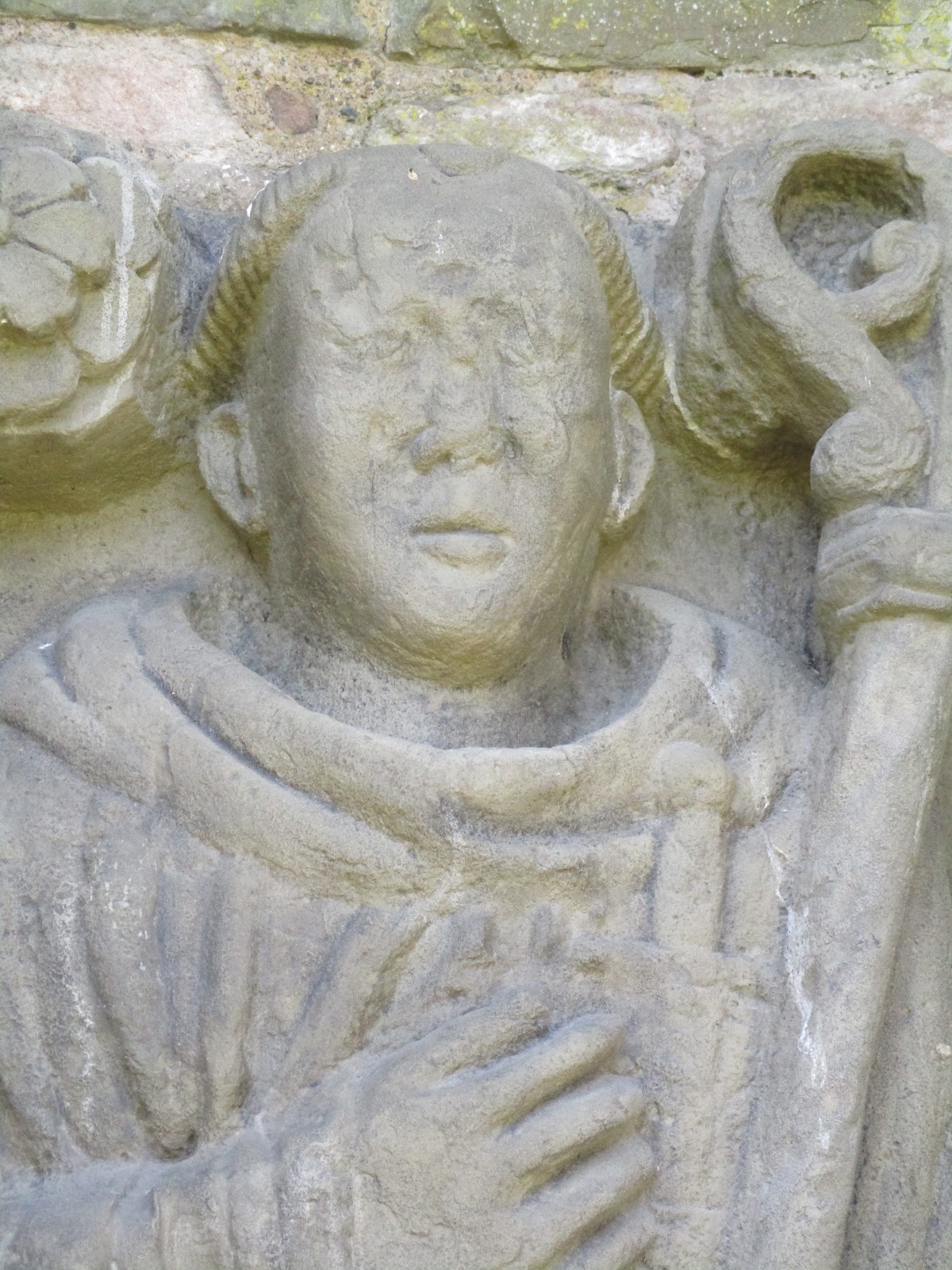
Mary, Queen of Scots' last night in Scotland was spent at Dundrennan Abbey in what is an idyllic spot these days. Summer weather and solitude with the attractive ruins made for a perfect morning.